

Published September 8, 2026. Information current as of September 8, 2026.
Choosing between active and passive cold chain shipping looks like a packaging decision. In practice, however, it is a lane decision.
A passive container is charged once, at packout, with a fixed amount of cooling. Ground handling, linehaul, weekend dwell, customs entry review, and the inland leg all can cause depletion. An active container removes that hard limit but adds power, servicing, and equipment availability to the list of things that have to go right.
The passive option has moved a long way. Vacuum-insulated reusable systems now hold pharmaceutical ranges for days rather than hours, can be verified before packout, and come with managed return programs. For a large share of international lanes, passive is no longer the compromise choice.
Below are the three categories of technology, what a modern passive shipper can do, and a framework for matching one to your product and lane. It also covers what happens when a shipment is held at the border and the clock keeps running, which is where a pharmaceutical cold chain freight forwarder earns its place.
This article provides general operational information for shippers of temperature-sensitive freight. It is not legal, regulatory, or medical advice, and it does not guarantee any temperature performance outcome.
What you’ll learn
- How passive, active, and deep cryogenic systems differ, and where each fits.
- What a current-generation vacuum-insulated passive shipper is capable of.
- Five points that decide the right solution for a given lane.
- What can and cannot be done to a shipment held at the border.
Index
- Three Categories of Temperature-Controlled Shipping
- What a Modern Passive Shipper Can Do
- A Selection Framework
- When the Lane Does Not Go According to Plan
- Where a Pharmaceutical Cold Chain Freight Forwarder Fits
- Before You Ship: A Practical Checklist
- Frequently Asked Questions
- Summary
Three Categories of Temperature-Controlled Shipping
These categories are not competing products; rather, they answer different questions.
Passive systems: insulation and phase change material
A passive shipper holds temperature with insulation plus a phase change material: a gel pack, a eutectic plate, or dry ice. Nothing is powered, and once the container is closed its performance is set. Passive systems are suitable for lanes where duration can be bounded with confidence, where power and servicing are not dependable at every node, and where simplicity of handling matters. The next section covers how far current vacuum-insulated systems have pushed this category.
Active systems: powered, regulated, serviceable
An active container regulates temperature with a compressor or thermoelectric unit, drawing on a battery or external supply. Envirotainer units are a common example in air freight. They hold a tighter band for longer and can be recharged in transit, but cost more per shipment, need charging points and trained handling at each node, and depend on unit availability at origin.
Deep cryogenic shippers for cell and gene therapies
Deep cryogenic dry shippers use liquid nitrogen in vapor phase to stay in the -150°C to -196°C range, and are the only option for many cell and gene therapy products. Volumes are small, unit values high, and handling requirements are the strictest of the three.
| Passive | Active | Deep cryogenic | |
|---|---|---|---|
| Temperature held by | Insulation plus phase change material | Powered regulation | Liquid nitrogen, vapor phase |
| Typical ranges | 15–25°C, 2–8°C, -20°C, around -70°C with dry ice | 15–25°C, 2–8°C, -20°C | -150°C to -196°C |
| Power required | No | Yes | No |
| Hold time | Fixed at packout | Extendable with servicing | Set by charge |
| Typical volume | Parcel to container | Pallet-level unit load device | Small, high value |
| Handling at each node | Simple | Charging and trained handling | Specialist handling |
What a Modern Passive Shipper Can Do
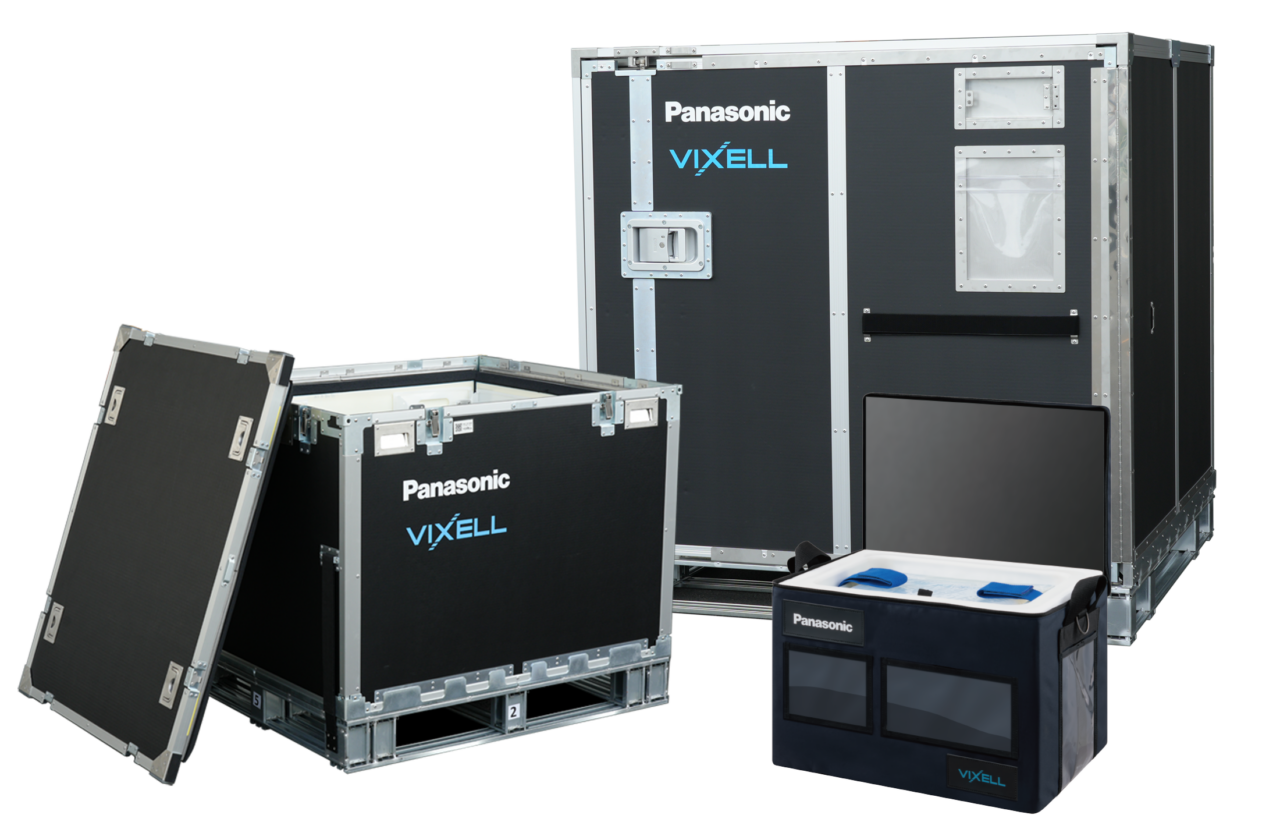
Most passive shipping is still done in foam boxes sized for a day or two. That is not the ceiling. Vacuum-insulated reusable systems such as Panasonic’s VIXELL line, which Nissin supplies and moves for pharmaceutical shippers, change the calculation on four fronts.
Hold times measured in days, not hours
VIXELL is built around what Panasonic calls a Vacuum Insulated Case, a joint-free molded panel that removes the seams where cold air escapes in conventional designs. Panasonic states that VIXELL “can keep preset temperature for 120 hours by box and 240 hours by pallet and container.”
One main unit covers several ranges. Swapping the thermal storage unit moves a VIXELL Box between 15–25°C, 2–8°C, -20°C, and below -60°C with dry ice, so one platform and one handling procedure can serve a mixed portfolio rather than four packaging systems.
Verification before packout, not after arrival
Damage to insulation is invisible from the outside, which is a common concern with any reusable container. VIXELL addresses it directly: a wireless vacuum sensor sits inside the Vacuum Insulated Case, and Panasonic states that an inspection board “enables users to instantly check condition of VIXELL Container, VIXELL Pallet and VIXELL Box before transportation.” The result is a pass or fail on a screen before the product goes in, which is the kind of documented pre-use check a quality team can point to in an audit.
Visibility during transit
The units are metal-free by design, so tracking devices can be fitted without shielding the signal, giving location and temperature data in transit where cellular coverage allows. Loggers, both USB and cloud type, come as part of the service rather than a separate procurement exercise.
Reusable, with the return handled
Reuse is feasible only if containers are returned. Panasonic operates what it calls a Circular Transportation System, in which it “covers the cost of returning VIXELL, and will sanitize the returned VIXELL to ensure it’s in optimal condition before being re-used,” and states that 95% of the materials can be recycled. This removes the return-logistics burden that makes many teams avoid reusable systems, and provides shippers working to reduce package waste something measurable to incorporate.
A Selection Framework
Capability is only half the decision. Five points settle the rest.
Start from product stability data
Stability data defines the range and the permitted excursion, not the logistics budget. Confirm it in writing with quality or regulatory affairs before comparing containers, including whether brief excursions are tolerated and how they must be documented.
Count the whole lane, not the flight
This is the most common error. Below is a real door-to-door journey for a below -70°C dry ice shipment from Maryland to Japan, taken from our validation records. Customer, product, and year are withheld.
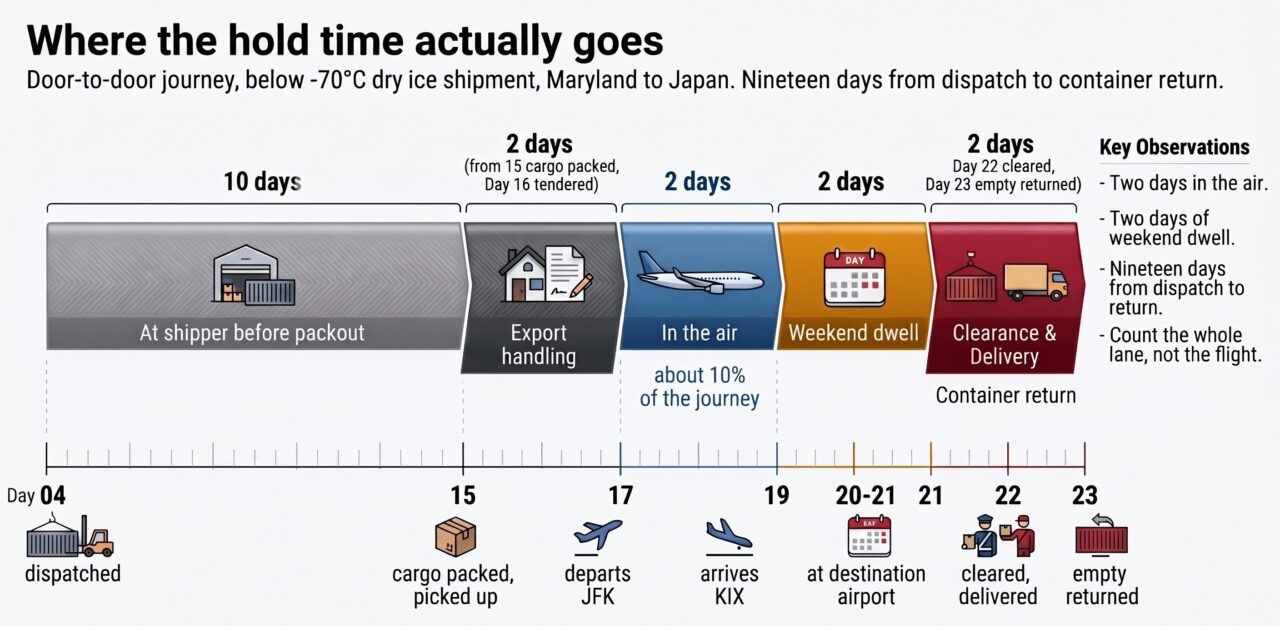
Two days in the air. Two days of weekend dwell at destination. Nineteen days from dispatch to return. This is why hold time matters: a container rated in hours would not have survived the weekend at KIX, while one rated in days would have absorbed it without intervention. Build the lane out step by step and put a realistic figure on each dwell: airline acceptance, hub transfer, customs entry review, weekend and holiday closures at both ends, and the inland leg.
Check the worst month, not the average
Ambient exposure varies by season and by node, and a transshipment point can be hotter than either endpoint. Where margin is thin, model the worst month.
Weigh the cost of failure against the cost of the container
Compare the per-shipment cost difference against one failure: product value, replacement lead time, the deviation investigation, and the effect on a clinical timeline. For high-value or time-critical products, the more capable container is frequently the cheaper decision.
Settle return logistics before the first shipment
Agree who arranges and pays the return, how units are cleaned and inspected between uses, and the turnaround time, since that sets how many units you need in circulation. Where the manufacturer runs a managed return program, most of this is already answered and what remains is scheduling the pickup, which your forwarder can carry.
Not sure how much of your transit time is actually in the air?
We can map a specific lane end to end, including customs review and
weekend dwell to figure out which container class fits your needs.
When the Lane Does Not Go According to Plan
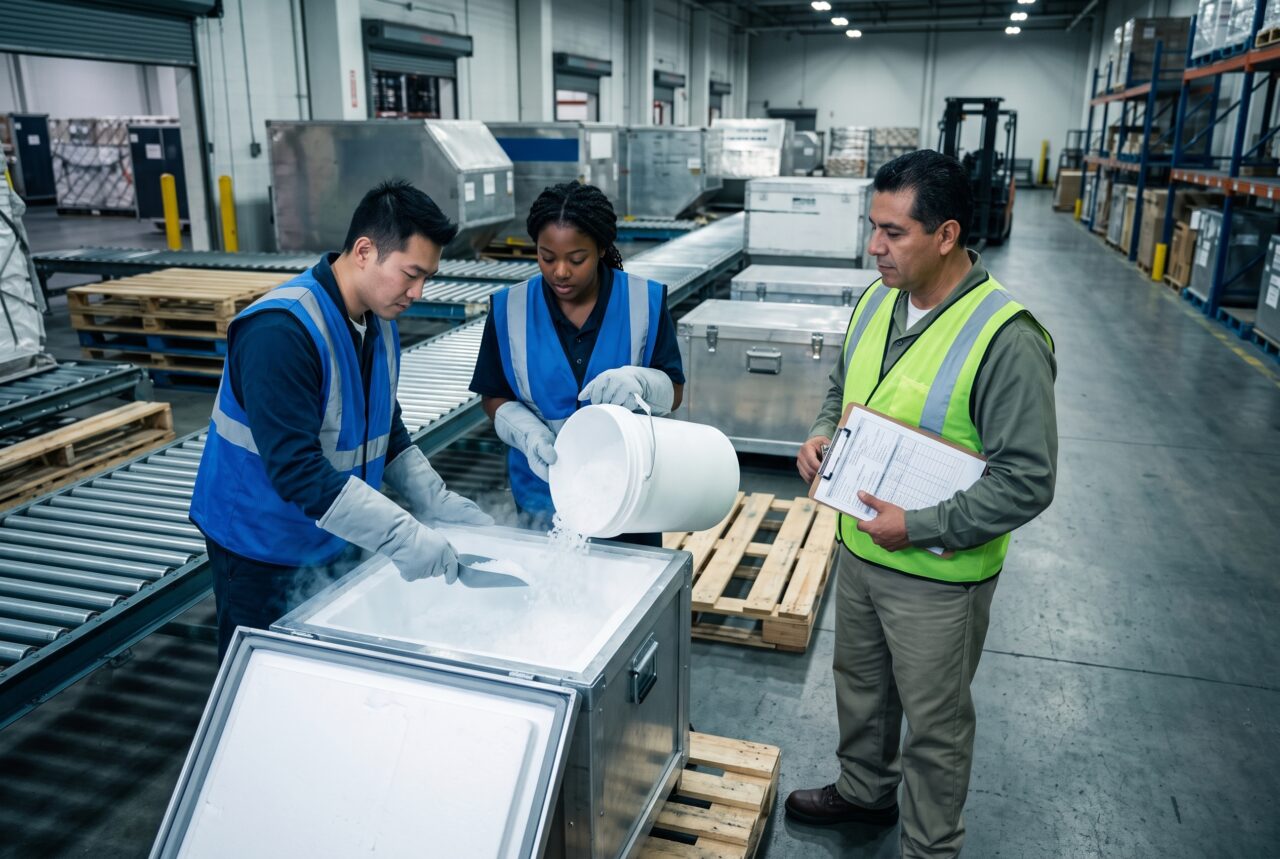
Container comparisons stop at packout. Shipments do not.
Entry review and the clock on a passive container
FDA-regulated products are screened at entry. Following initial review, a reviewer “may take one or more of the following actions”: release the product, “Request additional information, either through: Review of entry documents (documents required); and/or Examination/sample collection of the product,” or “Request detention of the product based on the appearance of a violation.”
Each review takes time, and on a passive shipment that time comes out of the remaining hold. A long hold time buys most of the margin you need. Filing the entry correctly the first time buys the rest, which is why the container and the customs entry should be planned together rather than by separate teams.
Replenishing dry ice and exchanging ice packs in transit
Where more margin is needed, cooling can be replenished through formal procedures. Where cargo sits in a CBP-approved bonded facility, operations on it require approval. CBP Form 3499, “Application and Approval to Manipulate, Examine, Sample or Transfer Goods,” is the application “to perform various operations on merchandise located at a Customs and Border Protection (CBP) approved bonded facility,” provided for under 19 U.S.C. 1562 and 19 CFR 158.43, 19.8, and 19.11, and can be approved as a blanket application for up to one year.
In practice, this is what allows dry ice to be added to a held shipment at an airline terminal rather than watching the hold time expire. It needs a broker who files it as routine and a handling agent that can do the work.
Why the inland warehouse step matters
Not every replenishment can happen at the airport. On Japan-to-US and China-to-US lanes, we route cargo needing replenishment to our Chicago warehouse, where dry ice and ice packs are exchanged before final delivery. A typical sequence is arrival with customs and partner government agency release on one day, warehouse re-icing the next, delivery the day after. Building that step into the plan is straightforward. Improvising it once a container is near its limit is not.
Where a Pharmaceutical Cold Chain Freight Forwarder Fits
A manufacturer can tell you what a container does. A pharmaceutical cold chain freight forwarder is responsible for the time between packout and delivery, which is what determines the container’s performance.
Nissin International Transport U.S.A., Inc. is a freight forwarder and licensed U.S. customs broker, and part of the Nissin group, which Panasonic’s published materials name as the forwarding partner coordinating transportation for its VIXELL service. In practice that means four things.
We are not tied to one technology. Our cold chain service covers passive systems using Panasonic VIXELL, active systems using Envirotainer, and deep cryogenic dry shippers, spanning 15–25°C, 2–8°C, -20°C, around -70°C with dry ice, and -150°C to -196°C. Our recommendation follows the lane, not the equipment we happen to hold.
We file the entry ourselves. As a licensed customs broker, we submit the customs and partner government agency data that determines how long review takes, and we can file a manipulation application when a shipment needs cooling replenished in a bonded facility.
We operate the warehouse where the replenishment happens. Our Chicago facility provides dry ice refills and ice pack exchanges mid-journey, giving a delayed shipment fresh cooling before the final delivery leg. Note that this is a replenishment point, not refrigerated storage.
We document the lane before you commit to it. The journey table above comes from our own validation records. A validated trial on a new lane, with loggers fitted and the temperature trace retained, is how a container specification stops being an assumption.
We do not manufacture containers, and we are not a substitute for your quality or regulatory affairs function. What we do is put the container, the routing, the customs filing, and the warehouse step into a single plan.
Before You Ship: A Practical Checklist
- Confirm the required range and permitted excursions in writing with quality or regulatory affairs.
- Build the lane step by step and total the hours, including weekend and holiday dwell.
- Add contingency for customs entry review and any partner government agency examination.
- Check ambient conditions for the worst month on the route, not the average.
- Match the container’s published hold time to that total, with margin.
- Verify reusable unit condition before packout, using the manufacturer’s method.
- Fit and register a data logger, and agree who retrieves the record.
- Decide where cooling can be replenished if the shipment is delayed.
- Confirm the return path, cleaning, and turnaround for reusable units.
- Check dry ice quantities against carrier and dangerous goods requirements.
Frequently Asked Questions
What is the difference between passive and active temperature-controlled shipping?
A passive shipper holds temperature with insulation and a phase change material such as gel packs or dry ice, charged once at packout. An active shipper regulates temperature with a powered unit and can be recharged in transit. Passive is simpler and cheaper per shipment, and current vacuum-insulated systems hold for several days. Active holds even longer and is tighter, but depends on power, equipment availability, and trained handling.
How long can a passive shipper hold temperature?
It depends on the model, the temperature range, and ambient conditions. Foam systems are typically rated in hours to a couple of days. Vacuum-insulated systems go further: Panasonic publishes 120 hours for VIXELL Box and 240 hours for VIXELL Pallet and Container, measured under the external conditions stated in its specification tables. Match the rating to your total door-to-door time, not to the flight.
What happens if a temperature-controlled shipment is held at customs?
The hold time keeps running. If the cargo sits in a CBP-approved bonded facility, an approved application on CBP Form 3499 allows specified operations on the merchandise, which is how dry ice can be replenished at a terminal. Whether that is practical depends on the facility, the handling agent, and how quickly the filing is made, so plan ahead before the shipment moves.
Are reusable shippers more expensive than single-use packaging?
The unit cost is higher, but compare over the whole cycle: number of uses, return freight, cleaning and inspection, storage of empties, and disposal costs avoided. Where the manufacturer runs a managed return program covering return cost and sanitization, as Panasonic does for VIXELL, much of the reverse-logistics burden disappears and reusable systems become straightforward on repeat lanes.
How do I confirm a reusable shipper is still performing before I use it?
Make it a documented pre-use step. Some systems support this directly: Panasonic states that an inspection board “enables users to instantly check condition of VIXELL Container, VIXELL Pallet and VIXELL Box before transportation,” reading a wireless vacuum sensor inside the unit. Where no such mechanism exists, agree on an inspection and requalification interval with the supplier.
Which temperature ranges are used for pharmaceutical shipments?
The common ranges are controlled room temperature at 15–25°C, refrigerated at 2–8°C, frozen at around -20°C, ultra-cold at around -70°C with dry ice, and deep cryogenic at -150°C to -196°C with liquid nitrogen. The applicable range comes from the product’s stability data and approved labeling, not from what is convenient to ship.
Summary
- The choice among passive, active, and deep cryogenic follows from the product, the lane, and the cost of failure.
- Vacuum-insulated reusable systems have pushed passive hold times into days, with pre-use verification and managed returns, so passive now covers far more international lanes than it previously did.
- Size the container against the whole door-to-door journey. Flight time is often a small fraction of it.
- Plan for the shipment being held: decide in advance where cooling could be replenished, and who would file for it.
- The container, the customs entry, and the warehouse step are one plan, not three.
Every temperature-controlled shipment has its own constraints: stability data, lane, transit time, customs profile, and what happens if it is held. Our team can review your requirements, recommend a container class and routing, and coordinate the customs and warehouse steps that keep the clock from running out.
Disclaimer
Information in this article is current as of September 8, 2026. Product specifications and import procedures change. Published hold times are manufacturer measurements taken under stated conditions and are not guarantees of performance on any specific lane; actual performance depends on ambient temperature, transit duration, handling, and packout. Requirements for a given shipment depend on the product, its regulatory classification, the route, and the receiving market. Confirm them with your regulatory affairs or quality team, and with counsel where appropriate.
Nissin International Transport U.S.A., Inc. is a freight forwarder and licensed U.S. customs broker. We support container selection, routing, customs filing, warehousing, data logging, and documentation. We do not provide legal or regulatory advice and do not certify regulatory compliance on a shipper’s behalf.
VIXELL is a product of Panasonic Corporation. Envirotainer are trademarks of their respective owners. Product specifications cited here are drawn from the manufacturers’ published materials.
References
- Panasonic Corporation, Refrigeration and Insulation Devices Business Unit. VIXELL brochure (English), published September 2025.
- U.S. Food and Drug Administration. Entry Review.
- U.S. Customs and Border Protection. Agency Information Collection Activities: Application and Approval To Manipulate, Examine, Sample or Transfer Goods (CBP Form 3499), Federal Register, November 27, 2024.
